
You treated your cat for fleas, cleaned the house, and thought the problem was finally over. Then, a few days later, you notice your cat scratching again.
If your cat still has fleas after treatment, don’t panic! It does not necessarily mean the flea medicine failed.
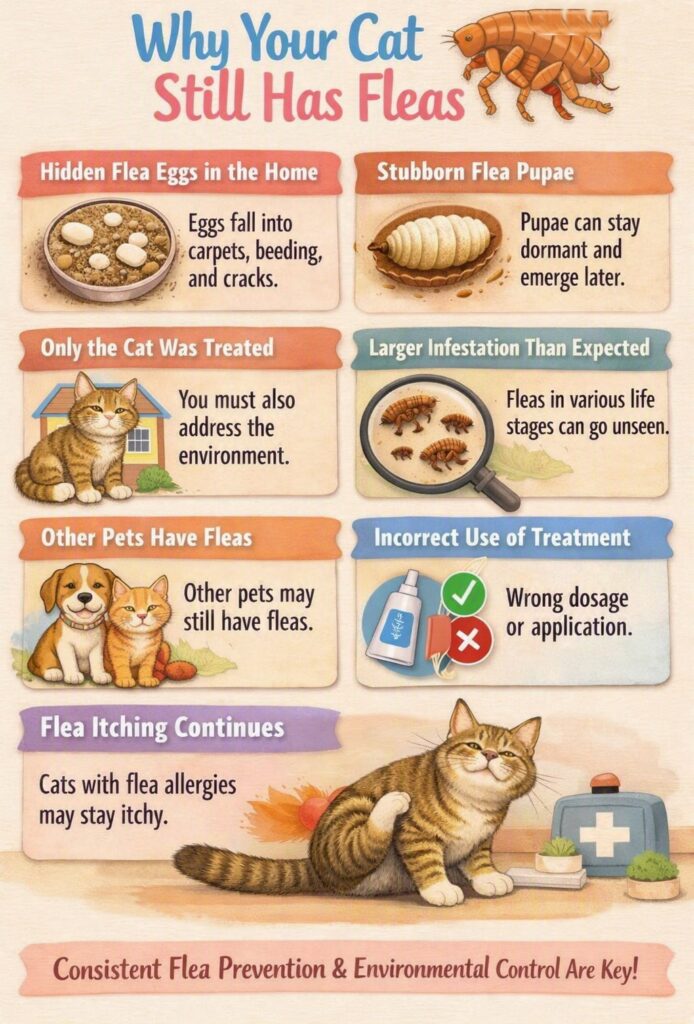
Fleas have a surprisingly persistent life cycle. Adult fleas live on your cat, but eggs, larvae, and pupae can be hiding in carpets, bedding, furniture, cracks, and other areas around your home. This is one of the main reasons a cat can appear to have fleas even after treatment.
The good news is that you can usually get the situation under control by treating both your cat and the environment and staying consistent with the treatment schedule.
Why does my cat still have fleas after treatment?
The most common explanation is that your cat is encountering newly emerged fleas from the environment.
A flea does not spend its entire life on your cat. The flea life cycle includes four stages: egg, larva, pupa, and adult. Adult fleas feed on animals, while the immature stages develop mostly in the environment.
This means you can successfully kill many of the adult fleas on your cat while flea eggs and pupae remain hidden around your home. As those immature fleas develop, new adults can emerge and jump onto your cat.
So when you ask, “Why does my cat still have fleas after treatment?”, the answer may simply be that the infestation has not been completely broken yet.
1. Flea eggs are still hiding in your home
Female fleas lay eggs on the animal, but the eggs can quickly fall into the surrounding environment.
They can end up in:
- Carpets
- Cat beds
- Blankets
- Sofas
- Under furniture
- Cracks along floors
- Areas where your cat regularly sleeps
The eggs are tiny, so you are unlikely to notice them during normal cleaning. This is why treating only your cat may not be enough when you have an established flea infestation.
2. Flea pupae are extremely difficult to eliminate
This is one of the biggest reasons people think their flea treatment is not working.
The flea pupa develops inside a protective cocoon. These pupae can remain in the environment and emerge when conditions are suitable or when they detect signs that a host is nearby.
So you may clean your home, treat your cat, and see fewer fleas, only to notice new adult fleas later. That does not automatically mean the treatment failed. It can mean that previously developed pupae are continuing to emerge.
3. You treated the cat but not the environment
If your cat keeps getting exposed to fleas inside the home, you can end up in a frustrating cycle:
Fleas on cat → eggs in environment → new fleas emerge → fleas jump onto cat → more eggs
Breaking that cycle requires environmental control as well as appropriate flea prevention for the cat. Veterinary guidance recommends addressing both the pet and the environment when dealing with an established infestation.
4. The flea infestation was larger than it looked
Seeing two or three fleas on your cat does not necessarily mean there are only two or three fleas in your home.
Most flea stages are not living on your cat. Eggs, larvae, and pupae can be hidden in the environment, making the actual size of an infestation difficult to judge just by looking at your pet.
This is why a severe infestation can take weeks or even several months to completely bring under control. CAPC specifically notes that established moderate to severe flea infestations may take several months to control.
5. Another pet in the house still has fleas
If you have a dog, cat, or another susceptible pet, don’t assume your treated cat is the only animal that needs attention. An untreated pet can continue to support the flea population and contribute to reinfestation.
CAPC recommends that every pet in the household be included in an appropriate flea-control program when dealing with an established infestation. If you have multiple pets, speak with your veterinarian about which products are appropriate for each animal.
6. The treatment wasn’t used exactly as directed
Another possible reason your cat still has fleas after treatment is incorrect application or timing.
Depending on the product, there may be specific instructions concerning:
- Your cat’s weight
- Age
- How often the product should be used
- Where a topical treatment should be applied
- Whether bathing affects the product
- Whether the product can be used with another medication
Don’t assume that using more products will make it work faster. Never increase the dose, apply treatments more frequently, or combine flea products unless your veterinarian specifically tells you to. ASPCA advises against using multiple flea medications together unless directed by a veterinarian because some combinations can result in excessive exposure to similar medications.
7. You are expecting every flea to disappear immediately
This is an important one. Some flea products work quickly against adult fleas, but flea control is not necessarily an instant process because immature stages can remain in the environment.
In other words, seeing a flea after treatment does not automatically prove that the medication is ineffective.What matters is whether the overall flea population is decreasing and whether you are consistently following an appropriate control plan.
If you continue finding significant numbers of live fleas despite correctly using the product, however, contact your veterinarian rather than repeatedly applying additional products yourself.
8. Your cat may still be itchy even after the fleas are decreasing
Here’s something many cat owners don’t realize: itching does not always disappear immediately just because the number of fleas has gone down.
Some cats develop flea allergy dermatitis, an allergic reaction to proteins in flea saliva. Even a small number of flea bites can trigger significant itching and inflammation in sensitive cats. They may develop redness, crusts, hair loss, scabs, or irritated skin.
I’ve actually seen this happen with a cat where the fleas were already gone, but the itching and skin inflammation continued. The reaction became severe enough that the cat needed veterinary treatment with corticosteroids to control the inflammation and relieve the intense itching. This really shows why ongoing scratching doesn’t always mean that the fleas are still there.
In other words, a cat that is still scratching does not necessarily have a large number of live fleas. The skin can remain inflamed after the original flea exposure, particularly in cats that are sensitive to flea bites. Other types of dermatitis or skin problems can also cause similar symptoms.
If your cat is constantly scratching, over-grooming, developing scabs, losing hair, or developing irritated skin, it’s better to have your veterinarian examine the skin rather than assuming that more flea medication is the answer. Never give your cat corticosteroids or increase flea treatment on your own, these medications and treatments should be used under veterinary guidance.
9. Your cat may be getting exposed again
Even if you successfully reduce the infestation inside your home, your cat can potentially encounter fleas again.
Outdoor areas, other animals, and wildlife can contribute to flea exposure. Fleas can also enter indoor environments and establish themselves in areas where pets spend time. This is one reason consistent flea prevention can be more effective than waiting until you see fleas before treating your cat.
What should you do if your cat still has fleas after treatment?
Don’t immediately reach for another flea product. Instead, work through this checklist.
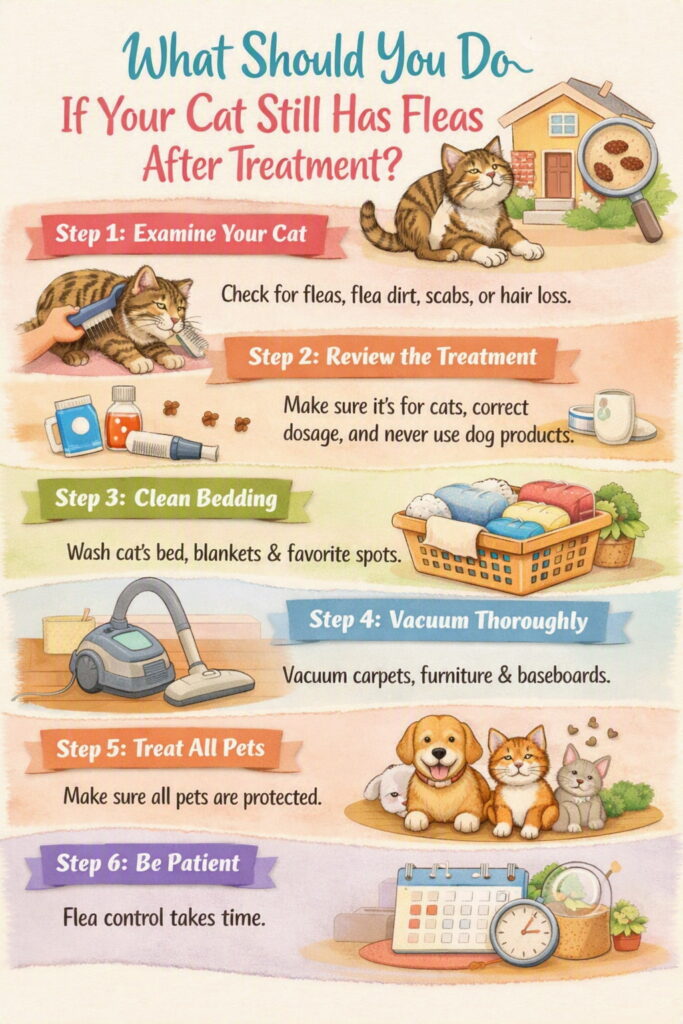
Step 1: Check your cat carefully
Use a fine-toothed flea comb, especially around areas such as the neck, back, abdomen, and near the base of the tail. Look for:
- Live fleas
- Tiny dark specks
- Excessive scratching
- Red bumps
- Scabs
- Hair loss
- Excessive grooming
Flea dirt can also be detected with a flea comb. When placed on a damp white surface, flea dirt can dissolve and turn reddish because it contains digested blood.
Step 2: Check the treatment you used
Look at the package and confirm that:
- It is specifically labeled for cats.
- It is appropriate for your cat’s weight and age.
- You used the recommended amount.
- You followed the application instructions.
- You have not accidentally used a dog product on your cat.
That last point is extremely important.
Never use a dog flea treatment on your cat without confirming that it is safe. Some flea products intended for dogs contain permethrin, which can be highly toxic to cats. Cats exposed to significant amounts of permethrin can develop neurological signs including unsteadiness, tremors, and seizures.
If you think your cat has been exposed to a product containing permethrin or another potentially toxic substance, contact a veterinarian or emergency veterinary service immediately.
Step 3: Wash your cat’s bedding
Wash bedding, blankets, and other washable fabrics where your cat regularly sleeps. Don’t forget places that are easy to overlook.
Your cat may have a favorite chair, corner of the sofa, blanket, or cushion that you don’t normally think of as “bedding.”
Step 4: Vacuum frequently
Vacuuming is an important part of environmental flea control.
Pay particular attention to:
- Carpets
- Rugs
- Upholstered furniture
- Under furniture
- Along baseboards
- Areas where your cat sleeps
Flea control guidance recommends frequent vacuuming and washing pet bedding as part of environmental management.
Step 5: Don’t forget the other pets
If you have more than one pet, talk to your veterinarian about flea prevention for every animal. Treating only the cat that you noticed scratching may allow the flea cycle to continue.
Step 6: Give the treatment plan time
One of the biggest mistakes is repeatedly changing treatments because you see a flea shortly after starting treatment. Established infestations can take time to control because the immature stages are already present in the environment.
If the number of fleas isn’t gradually decreasing, or your cat continues to have significant symptoms, ask your veterinarian to reassess the treatment plan.
How do you know if your cat still has fleas?
The easiest way to check is to use a flea comb.
Comb your cat carefully over a white towel, sheet of paper, or another light-colored surface. You are looking for either actual fleas or small dark particles that could be flea dirt.
If you find suspicious black specks, placing them on a damp white surface can help. Flea dirt typically produces a reddish-brown stain as it dissolves. However, not seeing a flea does not completely rule out an infestation because cats are excellent groomers, and fleas can be difficult to spot.
How long does it take to get rid of fleas on a cat?
There isn’t one exact number of days that applies to every cat or every infestation.
A flea product may kill adult fleas on the cat relatively quickly, but completely controlling an established infestation can take much longer because eggs, larvae, and pupae may already be present in the environment.
CAPC notes that moderate to severe infestations may take several months to bring under control. So if your cat still has fleas after treatment, don’t assume that you need a stronger product simply because you found another flea. The important question is whether the flea population is being brought under control.
Can indoor cats get fleas?
Yes. Indoor cats can get fleas. Being indoors reduces some exposure but does not make a cat completely protected from fleas. Fleas can enter the home and develop in indoor areas such as carpets, furniture, and other protected places.
That’s why an indoor cat can suddenly start scratching even though it never goes outside.
Should you keep treating your cat for fleas?
For many cats, ongoing flea prevention is recommended rather than treating only after fleas appear.
CAPC recommends year-round flea control for cats, although the appropriate prevention plan can depend on the individual animal and local flea exposure. Your veterinarian can help you choose a product based on your cat’s age, weight, health, lifestyle, and exposure risk.
When should you take your cat to the veterinarian?
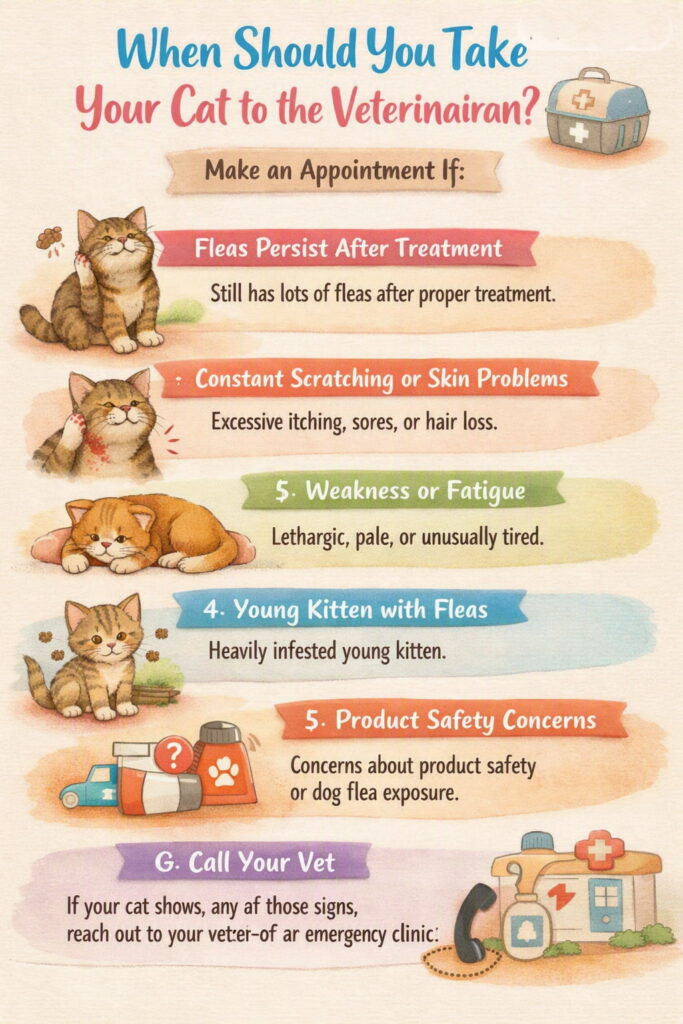
Make an appointment if:
- Your cat still has significant numbers of fleas despite appropriate treatment.
- Your cat is scratching constantly.
- Your cat has open wounds or severe skin irritation.
- Your cat is losing large amounts of hair.
- Your cat seems weak or unusually tired.
- Your cat is a young kitten with a heavy flea infestation.
- You are unsure whether the product you used is safe.
- You think your cat has been exposed to a dog flea product.
Heavy flea infestations can cause significant problems, particularly in vulnerable animals, and flea bites can also trigger allergic skin disease.
Conclusion
If your cat still has fleas after treatment, it doesn’t necessarily mean the flea medication didn’t work. The bigger problem is often the flea life cycle.
Adult fleas may be on your cat while eggs, larvae, and pupae are hiding in your home. New adult fleas can continue emerging and jumping onto your cat, making it seem as though the treatment has failed, therefore the best approach is to think of flea control as a whole-house process:
Treat the cat appropriately → treat every pet that needs treatment → clean the environment → stay consistent → give the flea life cycle time to break.
And remember: don’t use extra doses or combine flea medications on your own. In particular, never use a dog flea product containing permethrin on a cat. When you’re unsure about a product or your cat isn’t improving, your veterinarian is the safest person to guide the next step.
Frequently Asked Questions
Why does my cat still have fleas after treatment?
The most common reason is continued exposure to fleas emerging from the environment. Flea eggs, larvae, and pupae can remain in carpets, bedding, furniture, and other areas even after adult fleas on your cat have been killed.
How long can fleas live in a house?
The flea life cycle can vary depending on environmental conditions. Eggs, larvae, and pupae can develop in protected areas of the home, and pupae can remain dormant for extended periods before emerging. This is why an established infestation can take weeks or months to fully control.
Can my cat get fleas again after treatment?
Yes. A cat can be exposed to newly emerging fleas from an infested environment or through contact with an infested animal. Consistent prevention and environmental control help reduce reinfestation.
Why is my cat still scratching after flea treatment?
Your cat may still be reacting to previous flea bites, particularly if it has flea allergy dermatitis. Other skin conditions can also cause itching, so persistent or severe scratching deserves veterinary evaluation.
Can indoor cats get fleas?
Yes. Fleas can enter homes and develop in indoor environments, so an indoor lifestyle does not completely eliminate the risk.
Should I give my cat another flea treatment if I see a flea?
Not automatically. Check the product instructions and contact your veterinarian if you’re unsure. Never apply extra doses or combine flea medications unless your veterinarian tells you to do so.
Can I use dog flea medicine on my cat?
Never assume that a dog flea product is safe for cats. Products containing permethrin can be dangerous to cats and may cause serious neurological symptoms. Always use a product specifically labeled for cats and follow the instructions.
How do I get rid of fleas in my house with cats?
Vacuum frequently, wash your cat’s bedding and other washable fabrics, clean areas where your cat spends time, and use appropriate environmental flea-control measures when necessary. Treating the pets and the environment together is important for established infestations.
What does flea dirt look like on a cat?
Flea dirt usually looks like tiny dark or black specks in the coat. When placed on a damp white surface, it can dissolve and leave a reddish stain because flea feces contain digested blood.
Can fleas make cats sick?
Yes. Fleas can cause intense itching and skin irritation, and some cats develop flea allergy dermatitis. Heavy infestations can be particularly concerning in vulnerable animals. Fleas can also contribute to anemia in severe infestations and can transmit certain infectious agents and parasites. If your cat is showing other concerning symptoms, such as weight loss, increased thirst, or changes in urination, don’t assume that fleas are the only possible cause. Conditions such as kidney disease in cats can also cause changes in drinking, urination, appetite, and overall health, so persistent or unusual symptoms should be checked by a veterinarian.
What is the best flea treatment for cats?
There isn’t one flea treatment that is automatically best for every cat. The appropriate product depends on factors such as the cat’s age, weight, health, lifestyle, and exposure risk. Your veterinarian can recommend a product that is appropriate for your particular cat.
What if my cat still has fleas after treatment for several weeks?
If you’re using the product exactly as directed and you’re still finding significant numbers of fleas, contact your veterinarian. The infestation may require a more comprehensive environmental-control plan, or your cat’s itching may have another cause. Moderate to severe infestations can take months to fully control.