
A monkey figuring out how to open something, remembering where food was hidden, or using an object as a tool can make you wonder: just how smart are monkeys, really?
It is easy to look at a monkey’s expressive face and assume that there is a little human-like mind hiding behind those eyes. And monkeys really are remarkably capable animals. Depending on the species, they can learn from one another, remember individuals, solve problems, use tools, recognize quantities, and even make decisions based on whether they have enough information to solve a problem.
But comparing an animal’s intelligence to that of a human child is trickier than it sounds.
So, are monkeys as smart as a 2-year-old child? Are they smarter than dogs? And if they are that clever, does that mean a monkey could make a good pet?
Let’s find out.
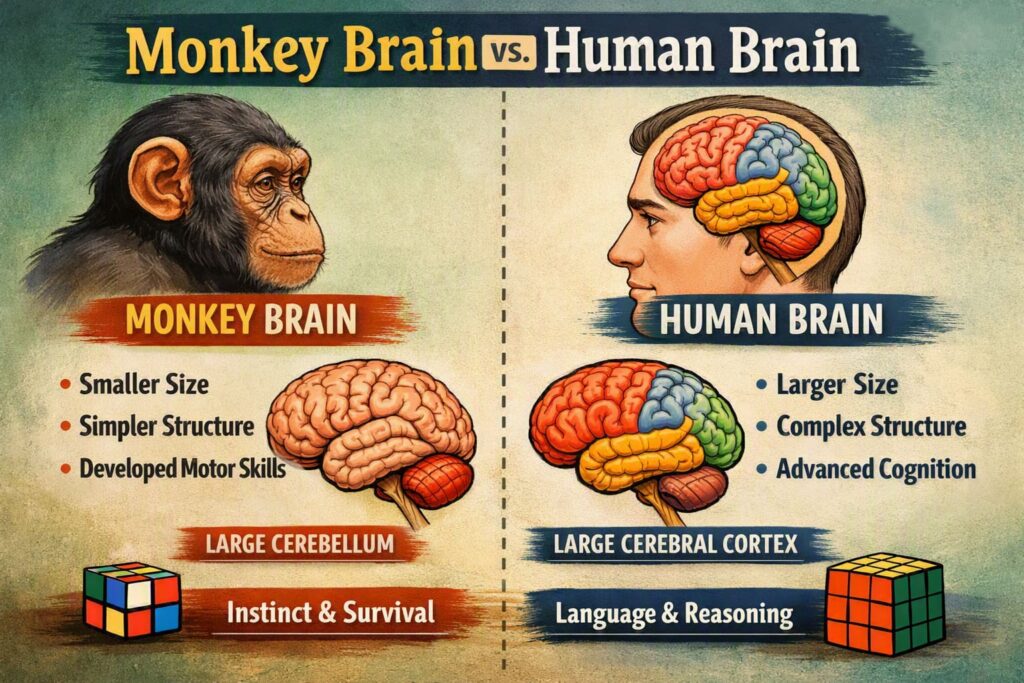
The monkey brain
Monkey brains are fascinating because, although they are much smaller than human brains, they are highly specialized for dealing with a complicated social and physical world. Monkeys have a well-developed cerebral cortex, the outer layer of the brain involved in processes such as learning, memory, decision-making, and problem-solving.
Their brains also contain regions involved in processing visual information and recognizing faces, which is particularly important for animals that spend much of their lives navigating complex social groups. Some monkeys can remember individuals, learn from watching others, adapt their behavior when circumstances change, and solve problems to obtain food.
Their intelligence isn’t simply about having a large brain, the organization and connectivity of the brain matter too. In fact, primate brains have evolved to support a remarkable combination of memory, sensory processing, motor control, and social cognition, helping monkeys keep track of both where the food is and who just stole it.
How Smart Are Monkeys and How Do scientists Test Monkey Intelligence?
When you hear “How smart are monkeys?”, you might picture a monkey solving a puzzle, opening a tricky container, or figuring out how to get food that seems completely out of reach. And surprisingly, these aren’t just funny internet moments, scientists have been testing monkeys’ cognitive abilities for decades.
Monkeys are among the most intelligent non-human animals, and their abilities can go far beyond simply learning tricks. Depending on the species, they can remember information, recognize individuals, learn from one another, use tools, solve problems, and even understand relationships between objects and people.
But how do scientists actually know how intelligent a monkey is? They don’t exactly give monkeys an IQ test and wait for the results! Instead, researchers design clever experiments that test specific abilities such as memory, problem-solving, learning, communication, self-control, and tool use.
Monkey Intelligence Is More Than Just Learning Tricks
A monkey remembering where food was hidden might seem simple, but it can reveal an important cognitive skill. Researchers can use these kinds of tasks to investigate how monkeys store and retrieve information.
Other experiments are more challenging. A monkey may have to figure out how to reach food using a tool, choose between different objects, remember a sequence, or work out a solution after its first attempt fails.
Scientists are particularly interested in whether monkeys can adapt their behavior when circumstances change. In other words, can they simply repeat something they have learned, or can they actually figure out a new problem?
That’s where things get interesting.
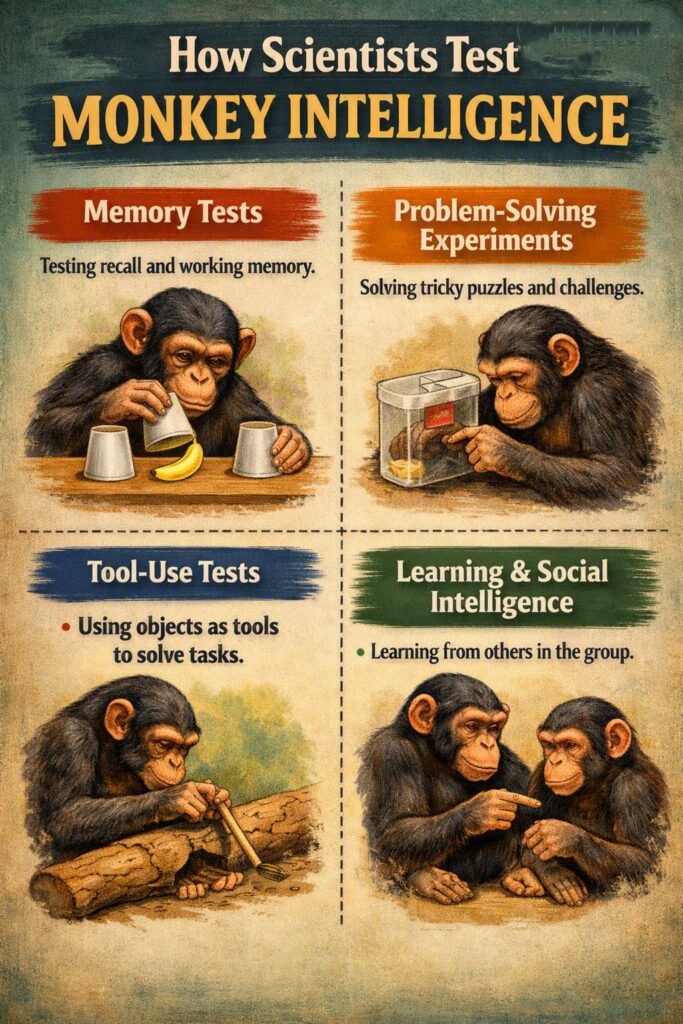
How Scientists Test Monkey Intelligence
Researchers use a variety of experiments to examine different aspects of cognition rather than treating intelligence as one single ability.
1. Memory Tests
One of the simplest ways researchers study monkey intelligence is by testing memory.
For example, scientists may hide food under one of several objects and then change the arrangement. The monkey has to remember where the food went rather than simply choosing the object that looks familiar.
Some experiments also test working memory; the ability to temporarily hold information in mind and use it to solve a problem.
2. Problem Solving Experiments
Give a monkey a problem with no obvious solution, and what happens next?
Researchers might provide food inside a container that cannot be opened directly or place a reward somewhere that requires several steps to reach.
The interesting part isn’t simply whether the monkey eventually succeeds. Scientists also look at how it approaches the problem, whether it learns from previous attempts, and whether it changes its strategy.
A monkey that tries something completely different after its first strategy fails may be demonstrating a degree of behavioral flexibility.
3. Tool Use Tests
Tool use is one of the most fascinating areas of monkey cognition.
Some monkeys have been observed using stones, sticks, leaves, and other objects to help obtain food or solve problems. In experiments, researchers can provide objects that can potentially be used as tools and observe whether the animals figure out how to use them.
Scientists can then ask an even bigger question: Did the monkey simply learn a behavior through trial and error, or did it understand something about how the tool could help?
4. Learning and Social Intelligence
Monkeys are highly social animals, so intelligence isn’t only about solving physical puzzles.
Researchers also study how monkeys learn from other members of their group. A monkey may observe another individual performing a behavior and later reproduce it.
Scientists can also examine whether monkeys recognize individuals, remember previous interactions, understand social relationships, or change their behavior depending on who is watching.
In a monkey’s world, knowing who is friend, who is rival, and who has access to food can be just as useful as knowing how to open a container.
Can Monkeys Understand Cause and Effect?
This is where monkey intelligence becomes especially fascinating.
Suppose a monkey discovers that pulling one object makes another object move and eventually releases food. Researchers can design experiments to determine whether the animal understands the relationship between the two events or is simply repeating actions that happened to work.
These experiments help scientists investigate whether monkeys can form mental representations of problems rather than relying entirely on trial and error.
What About the Famous “Monkey IQ”?
You may see claims online comparing monkey intelligence with the intelligence of a human toddler or giving monkeys an equivalent “IQ.”
These comparisons should be treated cautiously.
There isn’t a single IQ score that can accurately rank humans, monkeys, dogs, and other animals on the same scale. Different species have evolved different cognitive abilities that are useful for their particular environments.
A monkey might outperform a human in a task involving visual memory or rapid spatial information while struggling with something that is easy for humans.
So instead of asking “What is a monkey’s IQ?”, scientists usually ask more specific questions:
- How good is its memory?
- Can it solve a novel problem?
- Can it use tools?
- Can it learn from others?
- Can it remember past events?
- Can it exercise self-control?
- Can it understand relationships between objects or individuals?
Together, these abilities give researchers a much better picture of monkey intelligence.
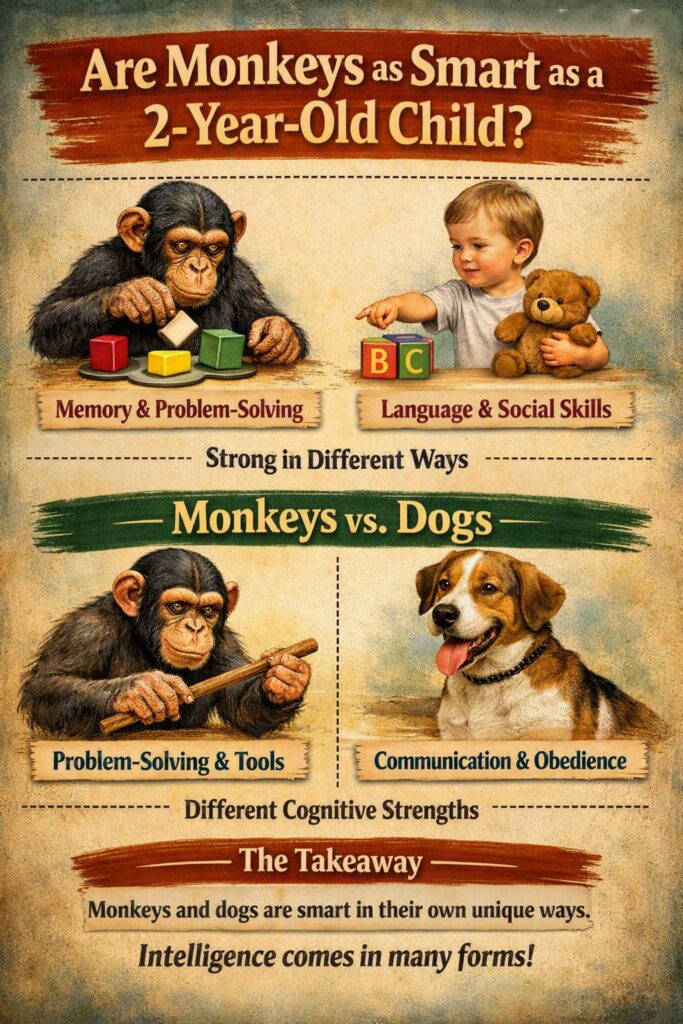
Are Monkeys as Smart as a 2 Year-Old Child?
You’ve probably heard people say that monkeys are about as intelligent as a 2 year-old child, or that they are smarter than dogs. The reality is a little more complicated.
Some monkeys can perform surprisingly well on tasks involving memory, problem-solving, learning, and object manipulation, and certain primates can match or even outperform young children on specific cognitive tasks. However, that doesn’t mean a monkey has the overall intelligence of a 2 year-old human.
Human children develop an extraordinary range of abilities, particularly in language, communication, social learning, and understanding other people’s thoughts. Comparing intelligence across species isn’t as simple as putting animals on the same IQ scale. A monkey may excel at a task involving spatial memory while a young child may be far better at understanding language or following a complex social interaction.
Are Monkeys Smarter Than Dogs?
That’s difficult to answer with a simple yes or no.
Both monkeys and dogs are intelligent, but their strengths are different. Monkeys tend to perform particularly well in areas such as problem-solving, manipulating objects, spatial reasoning, and certain forms of memory. Dogs, meanwhile, can be remarkably good at reading human behavior, learning commands, recognizing words, and responding to social cues.
So rather than asking which animal is “smarter,” scientists often compare specific cognitive abilities. In some experiments, monkeys may come out ahead; in others, dogs may have the advantage.
And this is exactly why scientists don’t use a single intelligence score to rank animals. Intelligence isn’t one skill, it’s a collection of abilities shaped by the challenges an animal has evolved to deal with.
If Monkeys Are So Clever, Would They Make Good Pets?
This is where things get interesting: being intelligent does not make an animal a good pet.
In fact, a monkey’s intelligence can make keeping one at home even more challenging. A clever animal needs plenty of mental stimulation, social interaction, enrichment, and opportunities to explore. A monkey that becomes bored or frustrated may find its own entertainment, and you probably won’t appreciate its definition of fun.
Monkeys can learn to open containers, manipulate objects, escape enclosures, and figure out how to get things they want. They also have complex social and behavioral needs that are extremely difficult to reproduce in a typical household.
So yes, monkeys are remarkably intelligent animals. But their intelligence is one of the reasons they aren’t suitable pets for most people, rather than a reason they would make good companions.
A smart monkey is still a monkey, not a tiny human in a fur coat!